Eva van Emden (she/her), freelance editor

Certified copy editor and proofreader

eva@vancouvereditor.com

January 26, 2012

Writing income for novelists

I just ran across this writeup by Jim C. Hines on his writing income throughout his career. (See also 2020.) Some things I notice: And while we’re on the subject, see Unasked-for Advice to New Writers About Money from John Scalzi, who made $164,000 in 2007.

January 15, 2012

Better than Great: A Plenitudinous Compendium of Wallopingly Fresh Superlatives by Arthur Plotnik

Oh, that word amazing—enforced by dropping one’s mandible on the second syllable and stretching out the MAYYY sound until a listener seems convinced. “I just ate the most aMAYYYzing cupcake.”

Better than Great Arthur PlotnikThe purpose of this book is to help people praise things more effectively, so it seems ironic that when I try to describe it, I’m struck with acute performance anxiety. It’s like being faced with the final exam, right now.

In Better than Great, the always-entertaining Arthur Plotnik (see also Spunk & Bite and The Elements of Editing) turns his attention to the problem of what to say when you’ve said “great”—or “perfect,” or “amazing”—too many times already. Faced with the challenge, I tend to wimp out, myself—to go the understatement route. “It was pretty good,” I mutter. What a missed opportunity!

Plotnik lays out the main categories of superlatives, separating the great from the sublime, the large from the intense, exploring the contradictions of baditude, and offers the reader a list of words to try out for each. Thus we have tyrannosaurian cockroaches and Niagaras of tears, and people who are so stellar they could carry water in a sieve. Your signature dish is pie-hole heaven, it’s so scarfable. That woman? A stoater; I’ve-fallen-and-I-can’t-get-up gorgeous. And who wouldn’t want to try a racy but quaffable red?

The appendices offer a few bonuses: a handy list for eponymous acclaim from Austenian to Zorroesque, with instructions for forming your own (is it Plotnikian or Plotnikesque?) and finally, to get you going, there’s the starter set of habit-breakers. It’s grea— wait, raveworthy!

So read this book and learn to blow the un-ignorable vuvuzela of praise.


Reviewed from an advance reading copy kindly sent to me by Viva Editions.

January 8, 2012

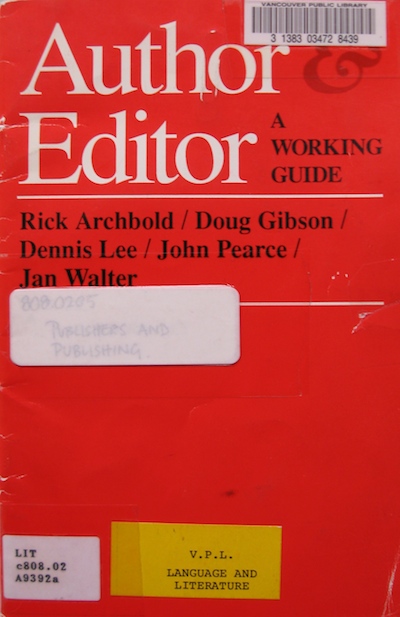
Author & Editor: A Working Guide

by Rick Archbold, Doug Gibson, Dennis Lee, John Pearce, and Jan Walter

Author and Editor: A Working Relationship

“There are books, even great ones, that make their way into print without ever being touched by an editor’s pencil, just as there are babies born without midwife or doctor. But they are not the norm and the dangers involved—in both cases—are considerable.”
This booklet outlines what an author needs to know about the publishing process. It covers the basics of manuscript acquisition, the decision to publish, contracts, how a publisher decides on the format and selling price of a book, the publishing schedule, and finally, it provides insight into and advice on managing the working relationship of the author and editor. It presents all of this information into a short (only 35 pages) and very readable package.

Where to get it

Publisher: The Book and Periodical Development Council, Toronto, Canada
Date: 1983
ISBN: 0130539260
AbeBooks
Vancouver Library

Reviewed from a library copy of the book.

January 7, 2012

Standard rates for freelance editing jobs

How much can you expect to pay a freelance editor? How do you estimate a freelance editing job?

For freelance editors and their clients, estimating the cost and time for a project is an important skill. Here are some of the factors to consider when estimating a project, as well as some industry rates.

Factors that affect editing speed

Difficulty of the material

The level of specialization and complexity of the document are important factors.
  • Is the material very specialized? Is there a lot of specialized terminology that the editor will have to look up or define a style for? Scientific, academic, and technical material (such as user manuals) takes longer to edit.
  • Is the formatting complex? Are there many levels of headings, figure and table captions, footnotes and endnotes, and citations to format?
  • Are there complex stylistic considerations such as mathematical formulas, other languages, units, currencies, etc.?
  • Is there a defined style for the document, or does the editor have to try to infer the style from the document itself? A style sheet can make the work go more quickly. On the other hand, long, complex, and contradictory guidelines can slow it down.

Current state of the manuscript

The state of the manuscript before editing makes a huge difference. The more errors the manuscript contains, the more time it will take to edit, especially if there are places where the meaning is unclear, or if the style and formatting are very inconsistent.

Clarity of requirements

Has the editing task been clearly defined? Has all the information needed to complete the job been provided? For instance for a stylistic edit, has the level and style of language to be used been specified? For a copy edit or proofread, is there a style sheet, and is it complete and consistent? Does the client respond quickly to questions?

Freelance editing rates

Some suggested standard pay scales and productivity rates for editing:
  1. What editors charge. Some guidelines on productivity rates and billing from the Editors’ Association of Canada.
  2. Janet Mackenzie suggested in her book The Editor’s Companion, written in 2004, that an editor who is competent according to the Australian Standards for Editing Practice is worth at least AUD 50 per hour (about CAN 53).
  3. Editorial Rates (updated April 2020) from the Editorial Freelancers Association in the US. A lot of people consider these rates to be low.

Freelance indexing rates

The Indexing Society of Canada has some notes on rates for indexing services. This is helpful both for indexers and their clients.

But that’s more than my hourly rate in my salaried job!

A freelancer’s hourly rate is higher than a salaried employee’s rate for a comparable job because it reflects the total cost of doing business. This includes expenses that are included in a salaried employee’s compensation:
  • Medical insurance premiums and medical and dental treatment.
  • Canada Pension Plan. Employees have half their CPP contributions covered by their employer. Self-employed people pay the whole thing. For the 2019 tax year, the deduction is 10.2% of taxable income to a maximum of $5,498.
  • Vacation pay, which is minimum 4% in BC.
  • Maintaining a workspace, computer, software, and reference materials.
A freelance business has some extra expenses as well:
  • Non-billable time spent finding work and handling administration.
  • Professional development: improving skills, staying up to date, and taking courses and certification exams.
  • Many editors need disability insurance, commercial liability insurance, and errors and omissions insurance.
There are various rules of thumb for how much a contractor needs to add to their hourly rate to approximate the pay of a salaried in-house employee. I think I’ve heard everything from 25% to 150% on top of the employee’s rate. A simple rule of thumb for calculating a freelancer’s hourly rate is to take the target annual salary and divide by 1,000.

These numbers can give you something to work with when you’re comparing the cost of freelancers to in-house employees. And if you see that you’re paying an unsustainably low rate for freelance work, you’ll know that you can expect a high turnover as your freelancers leave you for higher-paying contracts.

December 25, 2011

What changes can you safely make to a URL?

URLs don’t look so good in running text: they start with an incomprehensible code, they contain strange-looking punctation, and they run together all-lowercase words that are next to impossible to read. To try to make them look a little nicer, you may be tempted to leave some parts off and gussy up the rest with some camel casing. But how do you know what you can safely change and what will break the link? Here is what you can and cannot safely change.

Parts of a URL

Without getting into too much detail, the structure of a URL is something like this:
protocolsubdomaindomain nameTLDpath
http://paulgraham.com/hp.html
http://philip.greenspun.com/panda
http://philip.greenspun.com/images/pcd0803/florence-bike-6.4.jpg
For our purposes, when I say “hostname,” I mean the domain name including any subdomains (plus the second-level domain if present) plus the top-level domain (TLD). For example, google.com, scholar.google.com, or cra.gc.ca: everything that comes before the first slash.

Editing the URL

So there you are, faced with lots of unsightly and incomprehensible “http”s and forward slashes. How can you make these URLs fit into your text a little better?

Removing the protocol descriptor

Can you remove the http://? Yes.
http://www.google.com = www.google.com

The http in the URL stands for “hypertext transfer protocol,” which is the protocol used by the World Wide Web. It’s there to tell your browser that you are asking for a web page and that the browser should use the HTTP protocol as opposed to, say, FTP (file transfer protocol). But it’s reasonable to expect that any browser is going to assume HTTP as a default, so feel free to leave this off.

If the protocol descriptor is anything but http:// (for example https:// or ftp://) you should leave it in. Otherwise, browsers will assume that it’s an HTTP request and because it isn’t really, the request will fail (if you’re lucky, the server will be kind enough to redirect the request to the right URL, but it’s not a good idea to rely on this).

Changing capitalization

Can you add or remove capitalization? Sometimes. In the hostname, yes:
paulgraham.com = PaulGraham.com
but in the path, no.
slate.me/tbFnWs ≠ slate.me/tbfnws

For the hostname, it’s OK to have a house style that puts capital letters in the hostname (Scholar.Google.com), or even uses camel casing (OurCompany.com). However, the capitalization in the path (the section after the first slash) should not be changed: slate.me/tbFnWs is not the same as slate.me/tbfnws.

The reason is in the way that URLs are processed. The first thing that happens after you type in a URL and press Enter is that your browser sends a request out to the internet. DNS servers accept this request and translate the hostname (philip.greenspun.com) into an IP address (64.95.64.40), which is the address of the server that will have the files you’re looking for. Once the request reaches the server at 64.95.64.40, the server uses the path part of the URL to look through its file system and return the file you requested (/images/pcd0803/florence-bike-6.4.jpg). Only some web servers take the case of the path into account, but you shouldn’t assume that it won’t matter.

As a matter of style, use capital letters very sparingly. Traditionally URLs are all lowercase, and to the purist, capitalization looks funny. Keep your caps for the beginnings of words (PaulGraham.com) and never capitalize the whole URL or the top-level domain name (.com, .ca, etc.).

Removing the www

Can you add or remove a www on the beginning of a URL? No. At least, only sometimes.
www.pashley.co.uk ≠ pashley.co.uk

The www is a subdomain, just as the scholar in scholar.google.com is. If you take the subdomain designation off, for example to change www.google.com to google.com, you are changing the domain name.

OK, I admit that most (almost all) servers are configured to treat a domain name with and without the www subdomain designation the same way by forwarding traffic from one to the other, so you can usually get away with changing this. But it’s important to understand that if you add or remove a www it’s not the same domain name. If you are determined to add or remove a www, test the new form of the URL to make sure it works.

Try the URLs above and see what happens. The version without the www is invalid. If it works for you, you might be using a browser with aggressive “domain guessing.” That’s fine, but it’s far from every browser that does that: my versions of Chrome and Firefox won’t guess the URL in the above example. By the way, I’m not holding up the above sites as an example of bad design or configuration. I think it’s fine to accept only one version of your domain name, but editor beware.

Removing a terminal slash

Can you remove a slash from the end of a URL? Yes.

The final slash in each of these URLs can be omitted: www.google.com/ or philip.greenspun.com/panda/.

Edit, October 2022: I used to say that there was no web server in the world that wasn’t configured to behave as if there was a slash on the end of the URL, but I found one. Surprisingly, https://www.vlada.gov.sk/koalicia-vita-schvalenie-reformy-nemocnic/ behaves differently from https://www.vlada.gov.sk/koalicia-vita-schvalenie-reformy-nemocnic, and the latter gives a 404 not found error. So I have to amend my advice here to say that it’s almost always OK to remove the final slash.

But don’t these changes only affect people who use out-of-date browsers?

The pitfalls I’ve described above result from the way the DNS servers and web servers on the internet work, not the features of the user’s browser. However, some browsers use “domain guessing” to try other forms of a URL if the first request fails, so they’re more likely to be able to work around missing information in a URL. To make sure the URLs you print works for all your readers, be conservative about how you change them.