Eva van Emden (she/her), freelance editor

Certified copy editor and proofreader

eva@vancouvereditor.com

Showing posts with label books. Show all posts

July 1, 2023

Dreyer’s English: An Utterly Correct Guide to Clarity and Style by Benjamin Dreyer

Book cover

I picked up Dreyer’s English because I was intrigued by the words “Copy chief of Random House” on the cover and was further intrigued when I cracked it open and found a mention of Words into Type, a venerable editing reference. I found that the book is a pleasure to read, does an amazingly complete job of covering standard copy editing knowledge, and as a bonus, conveys a lot of insight into the copy editor’s role and job in editing fiction and creative nonfiction.

Every book on how to write has to take a certain philosophical stance on how prescriptivist to be. Dreyer takes a fairly pragmatic approach. As the copy chief of Random House, he talks to authors and he hears from readers. He respects authors’ ownership of their works, but knows that authors don’t want to get floods of letters from readers about grammar and usage matters that the author hadn’t even noticed. He doesn’t try to sweep back the tide of general usage, but he also trusts his taste and judgment.

In thirteen chapters, the book covers the gamut of copy editing knowledge, including “The Stuff in the Front”:
  • Tricky grammar points
  • Treatment of numbers
  • Cleaning out needless words
  • Which non-rules to ignore
  • Punctuation
“The Stuff in the Back” includes useful notes on commonly misspelled words* and common usage errors, as well as some miscellaneous points, including a discussion of “the habit of inauthentically attributing wisecracks, purported profundities, inspirational doggerel, and other bits of refrigerator-door wisdom to famous people.” From your lips to God’s ears, Mr. Dreyer. A useful part of the book is a set of things to watch out for in fiction, such as checking sunrise and sunset times, or anachronisms with postal codes and phone numbers to watch out for.

Reviewed from a library copy.

*I consider myself to be a good speller, but some of these (“elegiac”) gave me qualms. I couldn’t resist doing a computer-wide search for the misspelling elegaic, but to my relief, it didn’t turn up in any old editing projects, only in a published magazine not edited by me.

June 23, 2022

Recipes into Type: A Handbook for Cookbook Writers and Editors

Book cover: Recipes into Type
Recipes into Type, by Joan Whitman and Dolores Simon (HarperCollins, 1993), is the standard text on cookbook editing. It’s got detailed advice on all of the tricky aspects of writing a recipe: choosing a good title, what to put in the headnote, what to include in the ingredients list, writing a good recipe method, what to cross-reference and what not to, and what to put in a recipe note. It also goes into detail about the recipe-specific copy editing considerations: punctuation, numbers, and capitalization. The chapters on indexing, manuscript preparation, and design are not directed so much at editors, but the indexing chapter in particular is helpful to understand why the index is done the way it is. Chapter 9, Useful Information, contains various container sizes, US–metric conversions, British and US cooking terms, cooking temperatures, recommended amounts for servings, and substitutions, and the word list has the authors’ recommend spelling and capitalization for a variety of food words. Anyone modernizing an old recipe might find items like egg size conversions or oven temperature conversions (fairly hot: 400°F, British gas mark 6) very helpful.

Contents

  1. Setting Up a Recipe
  2. The Language of Recipes
  3. Punctuation
  4. Numbers
  5. Capitalization
  6. Indexing
  7. Preparation of the Manuscript
  8. Format and Typography
  9. Useful Information
  10. Word List

As a copy editor, I find that numbers and capitalization are a very tricky area where authors and editors can take a variety of approaches. A cookbook combines narrative text in the book introduction and the recipe introductions with more technical and number-intensive text in the ingredients list and recipe method, and deciding which numbers to spell out where requires some thought. On the other hand, spelling out numbers in one place and using figures in another looks inconsistent. There are also decisions to be made about whether recipe titles are capitalized when cross-referenced elsewhere in the text, and how sub-recipes are capitalized. Recipes into Type describes the various styles and how to apply them. For some guidelines on the endless questions about which cheeses and wines to capitalize, Recipes into Type quotes the “Wines without Caps” instalment of On Language for some general guidelines.

The book is getting old, and shows its age in the chapters on design and preparation of the manuscript, but the information in the other chapters is still relevant, and the conventions for ingredients lists, recipe methods, and capitalization match what I currently see people using. Now, did I edit or proofread more than forty cookbooks before I read this book? Yes, I did. I was able to get by with the publisher’s house style guides, and the work done by the in-house editors always laid a solid base for my copy edit. However, if you are working for a self-publishing author, or for a publisher who does not specialize in cookbook publishing, or if you would like to dig a little more deeply into best practices for recipe writing, I think this book will be extremely useful.

November 2, 2016

Some notes on copyright

These are a few summary notes that I started writing when I read Lesley Ellen Harris’s Canadian Copyright Law (see below for more information about the book). This is just a bit of basic, introductory information and doesn’t include lots of good stuff like the categories of fair dealing.

Types of intellectual property

  1. Patent: devices, formulas, processes, or improvements to existing patents.
  2. Trademark: word, symbol, logo, or distinctive shape used to distinguish a product.
  3. Industrial design: shape, pattern, or ornamentation.
  4. Copyright: protects text, pictures, art, audio recordings, film, software, etc.
  5. Confidential information and trade secrets: ideas and information that should be kept confidential because of the terms of a relationship.

Copyright law in Canada

  • Falls under federal jurisdiction, under the Copyright Act, enacted in 1924.
  • Major amendments to the Copyright Act were made in 1988 (Bill C-60), 1997 (Bill C-32), and 2012 (Bill C-11: Copyright Modernization Act).
  • This book does not discuss the “copyright pentalogy,” five supreme court rulings on copyright made on July 12, 2012. See The Copyright Pentalogy: How the Supreme Court of Canada Shook the Foundations of Canadian Copyright Law, edited by Michael Geist, for a discussion of the meaning of these five cases. Available as a p-book, e-book, or free PDF.
  • How copyright works: property rights versus copyright protection. There’s a right to physical property, but also rights to intangible property. When a user buys a book, they have certain rights: to read or give away the book, but other rights are protected: to reproduce or translate the book.

Creations eligible for copyright protection

A work is protected by copyright as soon as it is created, as long as it fulfills the following criteria:
  1. Original: It is a new work, not a copy.
  2. Fixed: It is set down in some reasonably durable form: written down (even if it’s on a napkin), recorded, saved on a hard drive, etc.
  3. Creator is a citizen or legal resident of Canada or another copyright treaty country, or the work is first published in a copyright treaty country.
There are some special rules for “Other subject-matter,” which means sound recordings, performances, and broadcasts.

International copyright law

Canada can extend copyright protection within countries that offer reciprocal protection to Canadian works. The following are international copyright treaties:
  1. Berne Convention
  2. Universal Copyright Convention (UCC)
  3. World Trade Organization (WTO)
  4. WIPO Copyright Treaty (WCT)
  5. WIPO Performances and Phonographs Treaty (WPPT) (for sound recordings and performances)

How to get copyright protection

  1. Protection is automatic

    Under Canadian copyright law, there are no formalities to obtaining copyright: it the protection exists as soon as the work comes into existence. You don’t have to register the work, deposit it, mark it with a special symbol, or include any particular statement. All countries that subscribe to the Berne Treaty (this includes Canada, the U.S., and the E.U.) have to allow automatic copyright when the work is created.
  2. Adding a copyright symbol and statement (optional)

    • Makes it absolutely clear that the material is protected.
    • Provides the name of the copyright holder to people seeking permissions.

    Format of a copyright notice

    The copyright notice should include the © symbol, the year of first publication, and the name of the copyright owner. Optionally, you can add the years of major revisions, or use a range of years.
  3. Registration and deposit (optional)

    You can register your work with the Canadian Intellectual Property Office (CIPO). CIPO copyright database search. (Results for “Life of Pi.”)
  4. “Poor man’s copyright”

    This method of proving ownership of a work seems to have entered folklore. The idea is that you put a copy of the work into an envelope and mail it to yourself. You leave the envelope sealed until you open it in court to prove that the work existed on the postmarked date. Skeptics point out that an obvious way to cheat is to mail yourself an unsealed envelope and put the work in later. Harris’s book describes poor man’s copyright as a method of providing evidence of existence and ownership, but suggests using registered mail, which presumably requires the envelope to be sealed, or mailing it directly to your lawyer.
  5. Registration with the U.S. Copyright Office

    Copyright protection is also automatic in the United States. However, you can choose to register your work with the U.S. Copyright Office. One of the benefits of doing this is that they accept deposits, which can help you prove a case down the road.
  6. Library and Archives Canada deposit

    Library and Archives Canada (LAC) requires copies of publications to be deposited, but this has nothing to do with copyright.
  7. Other depositing services

    Professional organizations and writers’ unions may provide depositing services. Using such a service will not cause you to be registered in the Canadian copyright database, but it might help you prove ownership of a work.

International copyright law

International copyright laws are relevant when you distribute your work outside of Canada, or use works created outside the country.

International copyright treaties

There is no international copyright law, just agreements between countries. In copyright treaties, each country agrees to give citizens of other signing countries the same protection they give their own citizens. One exception is for length of the copyright term.

Berne Convention

  • Canada is a member, which means that Canada’s Copyright Act has to meet the levels of protection specified in the Convention, and that Canada protects the rights of creators from countries that belong to the Berne Convention.
  • The text and a list of member countries is at Berne Convention for the Protection of Literary and Artistic Works.
  • The Berne Convention specifies automatic copyright protection. Once a creator in a member country has copyright, copyright protection is automatically granted in all member countries. Berne Convention countries are not allowed to require any formalities for obtaining copyright.

Other international conventions

Material protected by copyright

Not protected:
  • Ideas
  • Facts
Copyright law protects the expression of ideas and facts, but not the facts themselves.

Additional resources: Canadian law

Lesley Ellen Harris: Canadian Copyright Law
ISBN: 978-1-118-0751-8
October 2013, 368 pp.

Additional resources: U.S. law

September 30, 2016

It’s not about the turtle—or the elephants either

It’s been six months since Sir Terry Pratchett’s death, and I never did finish my thoughts.

I started reading him in my late teens, as I worked my way through a friend’s book collection. It took me a little while to warm up to him, but by the time I’d read Lords and Ladies, I was hooked. There is so much more there than funny footnotes, dwarf bread, and oograh.

I’ve met other Pratchett fans here and there—fellow students, the property manager of our old apartment—and every time it’s like discovering a common friend. People have their favourite characters. I’m partial to police commander Vimes in Night Watch, Thud, and Snuff, with his passionate sense of justice. But my favourite stories are the ones about the witch Granny Weatherwax with her goats, and her bees, and her herbs, who traded any possibility of normality and belonging to pursue knowledge instead.

It happens that I just read his collection of nonfiction A Slip of the Keyboard recently. Pratchett argued patiently and reasonably that people in the U.K. should be allowed to have the choice of assisted dying, and it seems that some change has come about.

Neil Gaiman on Terry Pratchett, from his wonderful introduction to Slip of the Keyboard.

February 22, 2016

The Don’t Just Read Dudes Project

I read a lot. It’s what I do when I’m not doing anything else. And since 2001, I’ve been keeping a list of what I’ve been reading. Once in a while, I scan through this list, and it’s noticeable that a lot of the authors on my list have . . . Y chromosomes. It’s also noticeable that there are a lot of fantastic books by women on the list. I loved The Martian and of course I ripped through Seveneves, but now I’m ready to spend some time with a different focus. Lois McMaster Bujold, Dorothy Sayers, Octavia Butler, Ann Leckie, Ursula Le Guin, Maggie Stiefvater, and Katherine Addison are all writers I’ve read recently who write (or wrote) masterful, insightful, gripping books that make me want to read more like them.

So I decided in January that I’m going out of my way to read more great books by women. I’m going to say twenty books in the first half of 2016. I’m counting rereads, but only if it’s been at least fifteen years since the first read. I’m also not sticking to this diet exclusively, because I wanted to finish Accidents in North American Mountaineering, and Fifty Degrees Below had showed up in the interlibrary loan queue (but I was a little frustrated with Fifty: as Frank burbles on about how logical it is to sleep in the park and hang out with homeless guys every night, I can’t stop noticing how unworkable that solution would be for most people with breasts). This isn’t going to be any effort to survey the great classics of female authors, by the way; I’m just going to read whatever seems fun.

Read so far

  1. What Makes This Book So Great by Jo Walton
  2. Ramona the Pest by Beverly Cleary
  3. Pride and Prejudice (reread) by Jane Austen
  4. The Left Hand of Darkness (reread) by Ursula Le Guin
  5. Ellen in Pieces by Caroline Adderson
  6. Over Sea, under Stone (again) by Susan Cooper. Book one of the Dark Is Rising series, which I read through except for The Dark Is Rising itself, which I reread two years ago.
  7. Greenwitch (again) by Susan Cooper
  8. The Grey King (again) by Susan Cooper
  9. Silver on the Tree by Susan Cooper. I think this was the first time. The other books are very good, but this one I didn’t like as much. Too much magic, I think.
  10. Tooth and Claw by Jo Walton
  11. Gentleman Jole and the Red Queen by Lois McMaster Bujold
  12. Climbing Free: My Life in the Vertical World by Lynn Hill and Greg Child. I’m very interested in motivation, and check out this one: “For me, the ascent represented a kind of performance art to demonstrate the values I believed in.”
  13. Ancillary Mercy by Ann Leckie
  14. Miss Manners’ Guide to Excruciatingly Correct Behavior by Judith Martin
  15. Merchanter’s Luck by C. J. Cherryh
  16. Wild: From Lost to Found on the Pacific Crest Trail by Cheryl Strayed
  17. The Just City by Jo Walton
  18. The Woefield Poultry Collective by Susan Juby
  19. Republic of Dirt by Susan Juby
  20. The Song of Achilles by Madeline Miller

Update, June 19

Earlier this month, I finished The Song of Achilles by Madeline Miller. It makes twenty books, so I’m calling the project finished for now. Lots of pleasant surprises in that book list. There was a bit of a digression when I blew off a Pulitzer-prize-winning Anne Tyler book to read a long piece of Harry Potter fan fiction. After the Harry Potter fan fic I had to reread the first two Harry Potters for comparison; then after The Song of Achilles, I had to dip into the Iliad for comparison.

March 2, 2013

The Craft of Writing Science Fiction That Sells by Ben Bova

Ben Bova: The Craft of Writing Science Fiction That Sells
Craftsmanship can be taught, and it is the one area where new writers consistently fall short. In most cases it is simple lack of craftsmanship that prevents a writer from leaving the slushpile. Like a carpenter who has never learned to drive nails straight, writers who have not learned craftsmanship will get nothing but pain for their efforts. That is why I have written this book: to help new writers learn a few things about the craftsmanship that goes into successful stories.
Not only does Ben Bova have a long list of book credits to his name, he was the editor of Analog and Omni, and he used to read all the manuscript submissions. The whole slush pile. As he says above, most of those manuscripts failed, not because of deficient ideas or bad artistly, but through faults in their basic mechanics.

The Craft of Writing Science Fiction That Sells is a short, to-the-point book that lays out the basics of crafting a good science fiction story. After a short introduction, the book has four sections: character, background, conflict, and plot. Each section has a chapter on theory, a full short story, and a chapter on practical considerations, with reference to the sample story. A final section discusses special considerations for novels.

Is research the key to good science fiction?

The book has some good points about research. How can you write what you know when you’re writing speculative fiction? Research. You find an astronaut and get them to coauthor the book. You move to New Mexico for a while. You spend serious time at the library. Bova suggests you keep a book of notes on plot, character sketches, background and setting, and everything else you have to keep straight.

That’s so much work on research alone, but maybe that’s what it takes. Dune is a great book because Frank Herbert built a detailed background of ecology,* politics, economics, and religion for his story. But books with poorly thought-out backgrounds are flat and uninteresting; their stories don’t ring true. Maybe, to make something great, you have to take the approach of doing as much work as possible.

* Although Dune is perhaps not the best example of good speculative science. For starters, it’s hard to think of a plausible way for sandworms to travel through sand.

Update: See also Christina Vasilevski’s review.

Reviewed from a library copy of the book.

January 17, 2013

The Publishing Business: From P-books to E-books by Kelvin Smith

Looking for an overview of the publishing industry? This book is written for the student preparing for a career in publishing. It provides a comprehensive overview, including the main areas of publishing (trade fiction, scientific and technical, educational, etc.), the tasks and jobs involved, and the process of how a publisher acquires material, produces a book, and sells the book. There’s plenty of attention to the economics, marketing, and branding of publishing, balanced with awareness of ethical issues.

The Publishing Business was released last August, and the case studies and discussion of recent developments in e-book rights and marketing are up to date. My favourite thing: the book is a big, attractive softcover with lots of colour pictures and visual interest. I recommend the book to anyone who’s considering working in publishing or simply wants to know more about how books are made.

I got this book as a door prize at an EAC-BC meeting. Iva Cheung, who kindly donated the book, has written a more comprehensive review.

What’s a reasonable e-book price?

One of the most interesting parts of The Publishing Business is a breakdown of publishing costs, which begins to clear up something I’ve been wondering about: loss leaders aside, why are the prices of e-books so close to the prices of paper books? Shouldn’t e-book buyers benefit from the savings in printing and shipping that this medium brings?

Sure. But printing and shipping are a smaller part of publishing costs than I thought. An e-book doesn’t incur the cost of printing, warehousing, distribution, and unsold stock, but it still needs to be written, edited, designed, laid out, and marketed. Even electronic distribution costs money.

According to The Publishing Business (page 63), the publisher’s costs break down approximately as follows:

  • marketing, warehousing, distribution, and unsold stock: 30%;
  • author’s royalty: 10%;
  • production (editing, design, and printing): 20%; and
  • other overhead (salaries, office, etc.): 30%.
Now consider that retailers typically keep about 45% of the cover price.* Given the possible savings in warehousing, distribution, unsold stock, and printing, I would guess that something like 20% of the cover price could be saved in e-book production.

That’s not a big difference. The $2.99 e-book may work when it comes after a higher-priced run that pays the bills, but if e-books are to be the dominant medium, they have to cost more than three dollars, or something’s got to give.

* E-book retailers may only take about 30%, but typically the author royalty is higher for e-books (The Publishing Business, page 36).

Reviewed from my own copy of the book.

October 3, 2012

Banned Books Week

And Tango Makes Three
I forgot it was Banned Books Week! Banned Books Week raises awareness of banned or challenged books and to persecution of authors.

Freedom to Read has a page on Censorship in Canada with a searchable list of banned and challenged books and magazines.

Most books that are challenged remain available; a challenge just means that someone made an effort to get a library or school to withdraw a book. However, some books and magazines are successfully made unavailable when they are seized at the border. Little Sister’s book shop in Vancouver has been fighting legal battles for years over censorship of books that describe gay and BDSM sexuality.

Read more

Banned Books Week on the American Library Association website.

Excerpt from Joseph Anton, Salman Rushdie’s memoir about living in hiding after he was threatened with death for writing The Satanic Verses.

September 11, 2012

Love Trumps Grief released

Book cover: Love Trumps Grief by Kristin Akin I’m excited to see that Love Trumps Grief, a book that I worked on this spring, has been released. It’s a memoir of a mother whose two sons were diagnosed with hemophagocytic lymphohistiocytosis (HLH), a rare blood disease. The only long-term treatment was a bone marrow transplant. Kristin Akin writes with strong emotion and unflinching courage about her family’s experience throughout her sons’ illness. I was deeply impressed not just by her perseverance, but at her ability to create love, joy, and even fun and humour in between the grimmest medical necessities.

The Matthew and Andrew Akin Foundation
OneMatch: Canadian bone marrow donation. The Canadian registry shares information internationally.
US National Marrow Donor Program

January 15, 2012

Better than Great: A Plenitudinous Compendium of Wallopingly Fresh Superlatives by Arthur Plotnik

Oh, that word amazing—enforced by dropping one’s mandible on the second syllable and stretching out the MAYYY sound until a listener seems convinced. “I just ate the most aMAYYYzing cupcake.”

Better than Great Arthur PlotnikThe purpose of this book is to help people praise things more effectively, so it seems ironic that when I try to describe it, I’m struck with acute performance anxiety. It’s like being faced with the final exam, right now.

In Better than Great, the always-entertaining Arthur Plotnik (see also Spunk & Bite and The Elements of Editing) turns his attention to the problem of what to say when you’ve said “great”—or “perfect,” or “amazing”—too many times already. Faced with the challenge, I tend to wimp out, myself—to go the understatement route. “It was pretty good,” I mutter. What a missed opportunity!

Plotnik lays out the main categories of superlatives, separating the great from the sublime, the large from the intense, exploring the contradictions of baditude, and offers the reader a list of words to try out for each. Thus we have tyrannosaurian cockroaches and Niagaras of tears, and people who are so stellar they could carry water in a sieve. Your signature dish is pie-hole heaven, it’s so scarfable. That woman? A stoater; I’ve-fallen-and-I-can’t-get-up gorgeous. And who wouldn’t want to try a racy but quaffable red?

The appendices offer a few bonuses: a handy list for eponymous acclaim from Austenian to Zorroesque, with instructions for forming your own (is it Plotnikian or Plotnikesque?) and finally, to get you going, there’s the starter set of habit-breakers. It’s grea— wait, raveworthy!

So read this book and learn to blow the un-ignorable vuvuzela of praise.


Reviewed from an advance reading copy kindly sent to me by Viva Editions.

January 8, 2012

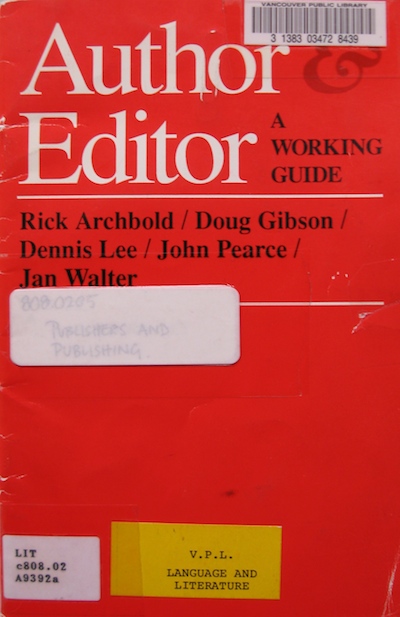
Author & Editor: A Working Guide

by Rick Archbold, Doug Gibson, Dennis Lee, John Pearce, and Jan Walter

Author and Editor: A Working Relationship

“There are books, even great ones, that make their way into print without ever being touched by an editor’s pencil, just as there are babies born without midwife or doctor. But they are not the norm and the dangers involved—in both cases—are considerable.”
This booklet outlines what an author needs to know about the publishing process. It covers the basics of manuscript acquisition, the decision to publish, contracts, how a publisher decides on the format and selling price of a book, the publishing schedule, and finally, it provides insight into and advice on managing the working relationship of the author and editor. It presents all of this information into a short (only 35 pages) and very readable package.

Where to get it

Publisher: The Book and Periodical Development Council, Toronto, Canada
Date: 1983
ISBN: 0130539260
AbeBooks
Vancouver Library

Reviewed from a library copy of the book.

October 31, 2011

Paris Review interview with William Gibson

Paris Review’s “The Art of Fiction No. 211” is a lovely long interview with William Gibson.
“. . . and something I’d heard about from these hobbyist characters from Seattle called the Internet. It was more tedious and more technical than anything I’d ever heard anybody talk about. It made ham ­radio sound really exciting.”

September 12, 2011

The Artful Edit: On the Practice of Editing Yourself by Susan Bell

Book cover: The Artful Edit by Susan Bell

Be your own editor

You won’t always get the perfect editor for your book, and you can’t rely on editors having time to do all the work they’d like to. Be your own editor as much as you can.

Susan Bell’s The Artful Edit is a guide for writers to help them edit their own work and to get the most out of their collaboration with an editor. Bell considers different strategies for editing during the writing process and suggests ideas for getting a fresh view of your draft. She then deals with the nuts and bolts of what to look for when editing. Later in the book, she steps back to look at the role of editing in art by interviewing non-print artists about how editing has improved their work and looking at some famous writer–editor relationships.

The book contains a lot of practical advice and examples. There are checklists and exercises to help you focus on specifics. Bell quotes from letters between F. Scott Fitzgerald and his editor, Max Perkins, to show how they worked on The Great Gatsby and quotes passages from different drafts of the manuscript to show the changes they made.

Although the book has some concrete stylistic advice (remove excessive “be” verbs, watch out for redundancy), this is not a style guide. Read it if you’re interested in larger issues (intention, structure, theme) and if you’re interested in thoughts about the role of the editor in creative writing.

Be a mechanic, not a judge. When you edit, do not ask yourself: Do I like this? Ask instead: Does this compel me and can I follow it? If the answer is no, figure out why.

—Susan Bell, The Artful Edit

Tips for getting distance from your draft

From The Artful Edit

  • Read it aloud, with or without an audience
  • Print it in a different font
  • Read it in different surroundings
  • Take a long break: don’t look at the manuscript at all for a few weeks
  • Go through the manuscript with someone else
  • Hang the pages on a line or lay them out on the floor to help you visualize the flow and layout
  • Send it away: giving your manuscript to someone else can make you see it with new eyes

Reviewed from a library copy of the book.

August 18, 2011

A Prehistoric Odyssey by Marie Mai Perron

Cover art for A Prehistoric Odyssey by Marie Mai Perron
A book that I copy edited last spring just came out a little while ago. It’s a great story, and I thoroughly enjoyed working on it.

When his friend tells him he’s solved time travel, Matthew Carrington jumps at the opportunity to prove his theory that dinosaurs could have been as intelligent as mammals. But in his desperation to save his career, he is forced to accept too many compromises in planning the expedition. Facing the prehistoric environment with incomplete information, unreliable technology, and a dangerously unstable team, science soon takes a back seat to survival.

The prehistoric environment is vividly described, with plenty of biological detail. The characters are very real, and their motives and agendas play out in a way that’s inevitable and surprising at the same time.

A Prehistoric Odyssey is for sale at iUniverse.com
ISBN: 978-1462018666
See a preview

May 15, 2011

Screenwriters can teach you a lot about fiction editing

I’m not a big movie watcher. When people ask me “Have you seen—,” the answer is usually “no.” Why then the interest in screenwriting? Because I am fascinated by stories, and good screenwriters know how to tell a story. (They also write a pretty good how-to book.) Here are some books on the subject, as well as an introductory note or two on writing screenplays. Thanks to Melva McLean for information about screenplay structure, scriptwriting software, where to find scripts online, and the screenwriting gurus (but any errors are mine!).

The screenplay format

Don’t mess with the format: twelve-point Courier on standard letter-sized paper. Character names and scene headings are in all caps, dialogue and action in upper and lower case.

Screenplay style guide

The Hollywood Standard by Christopher Riley.

Screenplay writing software

Celtx is a commonly used tool. It handles the formatting for you and saves you a lot of typing. A “movie” project will store the script, the novel, and the schedule, and integrates the screenplay with the schedule so that you can see which locations and characters are needed on which days. Best of all, there are a number of sample projects loaded, including the Wonderful Wizard of Oz screenplay and novel. Besides the movie project, there are a number of other project types, including novel and comic book.

I hear Final Draft is good too. Demo version available.

Sample scripts

Unlike novels, which tend to be guarded by their copyright holder, screenplays are often made available online. Fill your boots. I just hope you like monospaced fonts.
Simply Scripts
Script-O-Rama

How to structure a screenplay

This is where the gold is. How long should a screenplay be? What makes a satisfying story arc? Where does the climax go? How soon should the inciting incident come? Following the right structure in developing your story is essential to creating a satisfying experience for the viewer.

Of the authors I list below, Blake Snyder is the one who provides the most step-by-step formula for putting together a movie. Just to give you an idea, here’s a rough outline of a script, mostly based on Snyder’s beat sheet:

  • Length: about 90–120 pages. The rule of thumb is that one page of script comes out to about a minute of screen time.
  • Three acts: Act 1 introduces the situation; Act 2 complicates the situation; Act 3 resolves the situation.
  • Inciting incident (page 12 in a 110-page script): If it’s a murder mystery, a corpse has to be found. If it’s a love story, the lovers have to meet. In a hero’s journey story, the hero is presented with the call to action.
  • The transition into Act 2: The hero accepts the call, or something else happens to turn the plot in a new direction.
  • Fun and games, first half of Act 2: Action that results from the premise of the story. Most of the stuff that’s in the trailer comes from this part of the movie.
  • Second half of Act 2: Complications build until the crisis.
  • Transition into Act 3: Hero confronts their demons and turns the situation around using tools and lessons from earlier in the story.
  • Act 3: Climax and resolution.
See “Three Acts or What?” for a nice comparison of the Syd Field, Blake Snyder, and hero’s journey story structures.

Books about screenwriting

  • Save the Cat by Blake SnyderSave the Cat!: The Last Book On Screenwriting You’ll Ever Need—Blake Snyder. He has a nice list of genres and screenwriting devices (like the title “save the cat” trick), always with examples, and then discusses in detail his plan on how to set up the three-act structure that he believes is essential to delivering a satisfying experience. I certainly notice the structure he describes jumping out at me in movies like Avatar and The Sorcerer’s Apprentice. A very fun book.
  • Story by Robert McKeeStory: Substance, Structure, Style and The Principles of ScreenwritingRobert McKee. Excellent book. McKee is another script guru who consults and runs workshops. He’s also got a good list of screenwriting resources on his website.
  • The Definitive Guide to Screenwriting—Syd Field. Interesting, not as fun as Blake Snyder’s book, but it covers some different points, including more on the nuts and bolts of selling scripts.
  • Adventures in the Screen Trade by William GoldmanAdventures in the Screen Trade—William Goldman. Very entertaining. An analysis of the workings of the movie industry, from what makes a star (it’s someone who will bring people in to see the movie open) to the role of producers (he hasn’t the foggiest, although he knows they’re essential). There’s also plenty of concrete advice on screenwriting: how to write beginnings, how to write endings, how to protect the star—and how to protect your soul.
  • The Great Movies—Roger Ebert. He goes through about 100 movies that he thinks are important and talks about why they’re good and what they mean to him.

February 5, 2011

Garner’s Modern American Usage

[Edit: the fourth edition is called Modern English Usage and now covers global English usage.]

Garner's Modern American Usage
Bryan A. Garner’s Garner’s Modern American Usage is an impressive collection of essay entries on the usage of both individual words and more general categories, such as grammar and punctuation.

His philosophy is a combination of prescriptivism and descriptivism: on the one hand he describes certain usages as “inferior,” on the other hand he justifies that judgement by placing usages in the context of his language-change index. Usage changes over time (“terrific,” after all, used to mean “causing terror”) but that doesn’t mean that certain changes aren’t unnecessary (“priorize” for “prioritize”) or illogical (“could care less” for “couldn’t care less”). The language-change index goes from Stage 1: “rejected”, through Stages 2 through 4 (“widely shunned”, “widespread but . . .”, and “ubiquitous but . . .”) and finally arrives at Stage 5: “fully accepted.” To illustrate the language-change spectrum still further, he uses analogies from various other fields: golf (triple-bogey, double-bogey, etc.), legal infractions (felony, misdemeanor, ticket, warning), and—my favourite—etiquette, which compares a Stage 1 infraction to “audible farting.”

I was thinking that the language-change index could be analogized in fashion terms. Here’s a shot at it:

  • Stage 1: B.O.; wardrobe failure; fly undone
  • Stage 2: thong showing (“whale tail”); fluorescent pink Crocs
  • Stage 3: Uggs; socks and sandals
  • Stage 4: wearing white after Labour Day; shoes don’t match handbag
  • Stage 5: ready for the Oscars; royalty at a garden party
Some further reading:

Reviewed from my own copy of the book.

December 28, 2010

Spunk & Bite: A Writer’s Guide to Punchier, More Engaging Language & Style

Arthur Plotnik Spunk and Bite
“I can see dead writing” confesses Arthur Plotnik, and his mission is to teach people to make their writing come alive. To this end he advocates some controversial techniques (dialogue tags! obscure vocabulary! taken from the thesaurus!), but always with sensible advice about how to make them effective. He also goes after a few good, old-fashioned writing flaws, and I found his chapter on eliminating danglers (“Slathered with cream cheese, she brought over the bagels”) very useful.

The chapter on semicolons has a very good example of how the choice of punctuation affects the reader’s experience. Referring to President Kennedy’s famous “Ask not” line, Plotnik discusses how the pause between “Ask not what your country can do for you” and “Ask what you can do for your country” can be punctuated: comma, dash, period, colon, or semicolon? He says:

My own judgment would be based on these considerations:
  • The comma seems too hurried, too trivializing, as if one were saying: “Ask not for the large pizza, ask for the small one.”
  • The dash is too abrupt. With a dash, one expects an indirection, like, “Ask not what your country can do for you—ask how you can get heartburn relief.”
  • A period (full stop) allows time to anticipate the locution and to think, “Yeah, yeah, I get it.”
  • And a colon warns of some tedious enumeration: “Ask not what your country can do for you: Ask what you can do about poverty; ask what you can do about the environment; ask what you can . . .”
For more great writing advice from Arthur Plotnik, see Better than Great: A Plenitudinous Compendium of Wallopingly Fresh Superlatives (review), and his new edition of The Elements of Expression: Putting Thoughts into Words (review).

Reviewed from a copy borrowed from the library.