Eva van Emden (she/her), freelance editor

Certified copy editor and proofreader

eva@vancouvereditor.com

Showing posts with label resources for writers. Show all posts

December 29, 2013

The Elements of Expression: Putting Thoughts into Words by Arthur Plotnik

Arthur Plotnik: The Elements of Expression There’s an expression in Dutch: Doe maar gewoon, dan doe je al gek genoeg. It translates approximately as, “Why don’t you just act normal? That’s already strange enough.” And how right the Dutch are: rhetorical flourishes, weak jokes, arty effects, obscure language, and the breezy style that Strunk and White warned against are all reasons to toss a book over your shoulder. But, taken too much to heart, won’t this keep-it-normal philosophy result in Soviet-cell-block-grey writing? The literary equivalent of overcooked cabbage and brown rice without salt may not get thrown across the room, but it will end up gathering dust under the bed.

Somewhere between these two extremes is writing that catches attention without bolting on superfluous ornaments. The Elements of Expression tells you how to use concrete images and unfamiliar combinations of words to produce writing that is fresh and expressive and brings delight to the reader. Arthur Plotnik provides techniques for injecting force and power into your writing, and suggests a variety of places, from rap music to Shakespeare, to find new language. Most importantly, he tells you how to make this new language your own.

Don’t waste time finding your single real voice. We rarely find our real voice . . . Our voice can be a new voice—or several—that we make real, a voice in harmony with our roots but capable of expressing the full flower of the evolving self. Like everything that breaks from the ordinary, the new voice entails risks, apprehensions, missteps. These are reasonable costs of liberation.

I expected this to be a book about writing, so the chapter on oral presentation was a delightful added bonus. We’ve all been tortured by the People Who Should Be Banned from Presenting (the flaunters of their unpreparedness: “Prepare? Do gods prepare?”). In keeping with the theme of adding expressiveness, Plotnik pleads for effective voice modulation. In the past, the baby-talk sound of the kindergarten teacher who traversed an entire octave in one word and the android-like delivery of newscasters made me think that the best modulation is the one that nobody notices (“just act normal . . .”), but when you’re a small figure on a distant stage, the audience needs more animation than you would use when speaking face to face. Plotnik tells you how to use volume, tempo, and phrasing to make your presentation sing. He finishes with his own checklist of methods for reducing the terror of public speaking (bring a marked text and an extra copy).

As always, Plotnik is a joy to read. He shares his secrets generously, and he empathizes with the yearning for effective expression that all writers, however casual, feel.

Other books by Arthur Plotnik

Better than Great: A Plenitudinous Compendium of Wallopingly Fresh Superlatives (review)
Spunk & Bite: A Writer’s Guide to Punchier, More Engaging Language & Style (review)
Elements of Editing: A Modern Guide for Editors & Journalists
The Elements of Authorship (review)

Reviewed from my own copy of the book.

November 26, 2013

The Elements of Authorship by Arthur Plotnik

Arthur Plotnik: Elements of Authorship Arthur Plotnik is always fun to read. In this combination of manual and memoir, he presents the ins and outs of the world of writing—and he’s done it all: studying at the Iowa writers’ workshop, journalism, commercial writing, editing a magazine, you name it. If you’re committed to being a writer, this is your guide to the landscape of the trade.

The contents

  • Studying to write—the highlights of the writers workshops
  • Lessons to be learned from journalism
  • Writing full-time
  • Writing at home
  • Working as a commercial writer
  • How to please editors
  • The personal lives of writers
  • Getting published (“The Pit and the Pinnacle”)
  • Style and how to write well
  • Finances of writing and contracts
  • Being a poet
  • Technical considerations
  • Becoming obsolete
Every so often a newspaper reports on the “fecal dust” that blows through certain cities from the open latrines of shanty-towns. The imagery sticks in one’s mind, with that piercing word fecal and the unsettling notion of airborne waste. We thank heaven we don’t breathe it, yet day and night we are assailed by toxic drivel from office, media, and motor-mouthed acquaintances. Choked on this fecal verbiage, people turn to the literary word for refreshment.

For writers, the listener’s time is always suspended until the words can gather force. One attraction of writing is this magical opportunity to rummage for the bon mot or perfect squelch or ultimate love call while the world stands frozen. And so the writer struggles with words, chooses them with care, arranges them to refresh the listener’s mind and ear, then heaves them out and shops for better words and rearranges them for hours, days, months, until nothing can be added, excluded, or shifted to make them more refreshing, more stimulating. But when the words are uncorked in print, the effect is instantaneous: “By God, that’s what I would have said if I’d had a year to think about it!”

—“What Readers Want”

Reviewed from a library copy of the book.

September 28, 2013

Robert Mackwood at Word Vancouver: A literary agent’s take on publishing today

Today I was at a Word Vancouver talk by Robert Mackwood: A Literary Agent’s Take on Publishing Today, presented by the Canadian Authors Association. Robert Mackwood is the director and principal agent at Seventh Avenue Literary Agency. He works with non-fiction books.

Literary agents in Canada

There are only about twenty agents in Canada: five in Vancouver, one in Halifax, and the rest in Toronto. New York City probably has about 150.

Dealing with a literary agent

Robert gets about thirty to forty queries per week (about the same as ten years ago). He can see quite quickly whether he thinks the project is something he can sell. He charges 15%, and of course, only gets paid when he makes a deal. Most agents don’t have a lot of clients. He tries to keep his client list to under forty.

Write, don’t call.

What about the proposal? He didn’t get into too much detail about the format and nuts and bolts of the proposal. Just put together a short description of your project and yourself. Describe what you’ve done so far to promote your writing, and include the trail of yeses: writing contests, magazine articles, previous publications, and any other time someone said yes to your writing. What he doesn’t really like to hear: “I can finish the manuscript in three weeks.” “We’re going to make so much money on this!” “Oprah’s going to love this!” and, worst of all, “I’ve decided I’d like to be a writer!”

Should you self-publish?

Deciding on the best publishing route is too big a topic to go into here, but here are a few points:
Advantages to self-publishingAdvantages of conventional publishing
You keep all the profitsNo up-front expenditures
You have total controlThe publisher does the marketing
It’s fastYou get the credibility of the publisher’s brand
 You benefit from the publisher’s professional expertise
If you self-publish, you have to be the publisher. Don’t rush, and make sure you get a good editor, designer, and printer. Robert estimated that you’ll have to spend at least a couple of thousand dollars to make a book that you’ll be proud of.

An important point is that a self-published book that gets decent sales and some good reviews may be picked up and re-published by a conventional publisher.

October 29, 2012

The basics of libel law in Canada and the new responsible communication defence

I recently attended a Tyee master class: Responsible Journalism in 2012: The Changing Legal Landscape for Journalists, taught by Leo McGrady of McGrady and Company, a firm whose specialties include libel law and intellectual property.

The biggest take-home message? Libel risk is manageable. Don’t be too afraid to write. In the last few years, courts have set precedents in libel law that have shifted the balance toward freedom to publish, and it’s important to use this new freedom from libel chill to build a new culture of freedom of expression.

Why does “libel chill” matter? Don’t people only get sued for libel if they lie?

I saw this sentiment in a blog comment just now, and I think it’s an important misconception to address. No, you’re not only at risk if you lie. Consider the following situations:

You review a book. You say it’s terrible, that the author doesn’t know what they’re talking about, and that they can’t write for beans. You could get sued. See this case about negative book reviews on Amazon’s website, and this case about a negative academic review.

Or perhaps you find out that a Canadian company is doing business with a supplier in a developing country who treats its employees very badly. You know this because you have done interviews with reputable sources. But if you publish a statement like, “John Doe, who works for an NGO in the country, reports that workers don’t have access to basic safety equipment,” could you prove in a court of law that workers don’t have access to basic safety equipment? If not, you may not feel safe publishing that sentence.

That’s what they mean by “chill.”

What is libel?

Libel refers to defamation in written, printed, broadcasted, or other lasting form.
Defamation is an attack on a person’s character that attributes to the person some form of disgraceful conduct—dishonesty, cruelty, sexual misbehaviour, irresponsibility, and the like—in either personal or professional concerns.

Editing Canadian English, 2nd Ed. 11.67

How to protect yourself when you publish

  • Be right. If your statement is true and you can prove it (more about that later), you’re safe. In this case it doesn’t matter if your reporting is malicious, unfair, or unbalanced.
  • Be able to show that you’re right: be diligent in your research, and save your documentation.
  • If it turns out that you were wrong about something, you can mitigate the damages against you if you take the material down, publish a correction, and apologize. Make sure the apology is honest and sincere: don’t backtrack, don’t make an “attack” apology, and don’t say it was the plaintiff’s fault.

What are the consequences?

If you mitigate the damage as described above, by retracting and apologizing, the lawsuit may not happen at all. A typical award for damages is about $70,000, which isn’t really worth suing for. Although the loser may have to pay court fees (something like $120,000), they would typically end up paying only about a quarter of that unless an award for special costs was granted (unusual). If the defendant was very reasonable about mitigating the damage, they might not even have to pay the court costs.

Main legal defences against libel

  1. Truth. If your facts are correct and your evidence satisfies the court, then you’re not liable. However, if your statements are difficult to prove, or if you made a mistake and published something that wasn’t true, read on.
  2. Fair comment. Remember that a defamatory statement is more or less anything that damages a person’s reputation. Maybe you made statements of opinion that were highly uncomplimentary. For your writing to qualify as fair comment, you need to show that the statement was comment or opinion, that it is your honest opinion, that it’s based on true facts, and that it regards a matter of public interest. If you are proven to be malicious, that defeats this defence.
  3. Privilege. In some situations when the communicator and the receiver have an interest and a duty to exchange certain information, that communication may be protected. For example, an employer giving a reference to a future employer is a situation of “qualified privilege.” This defence is lost if the person making the statements is malicious or if the information is communicated beyond the group of people who have an interest in receiving the information. Increasingly, it seems that the public may be the interested party.
  4. Responsible publication. This is a relatively new defence that came out of the Grant v. Torstar case (see below). The defendant has to show two things:
    1. The matter is of public interest.
    2. The defendant acted in a responsible way.
    In deciding whether the defendant acted responsibly, a number of factors are considered:
    1. The seriousness of the allegation. More serious allegations require stronger evidence.
    2. The public importance of the matter.
    3. The urgency of the matter.
    4. The reliability of the source.
    5. Whether the plaintiff’s side of the story was sought and accurately reported. How important this is depends on the circumstances, but generally, consulting the person you’re writing about decreases your chances of getting your facts wrong.
    6. Whether the inclusion of the defamatory statement was justifiable.
    7. Whether the statement’s public interest lay in the fact that it was made rather than its truth. This can protect situations like reporting on a libel case, where it would be difficult to avoid repeating the defamatory statement.

Recent changes in Canadian libel law

Grant v. Torstar in 2009 was the case that resulted in the new guidelines for responsible journalism or responsible communication. The Court commented:
The existing common law rules mean, in effect, that the publisher must be certain before publication that it can prove the statement to be true in a court of law, should a suit be filed. Verification of the facts and reliability of the sources may lead a publisher to a reasonable certainty of their truth, but that is different from knowing that one will be able to prove their truth in a court of law, perhaps years later. This, in turn, may have a chilling effect on what is published. Information that is reliable and in the public’s interest to know may never see the light of day.

—paragraph 53

Wikipedia summary of Grant v. Torstar

Supreme Court of Canada Grant v. Torstar

Other considerations

Malice

“Actual malice” in a libel case is not personal dislike or even a personal vendetta. It means that the person making the statement had an ulterior motive or a lack of honest belief in the statement.

Repeating a statement

Quoting someone else does not distance you from liability. The contentious statement in the Grant v. Torstar case was a quoted statement from a local resident. The resident made the statement, but the newspaper was sued for printing it.

Differences between Canadian and US law

Because libel law is different in the United States, previous publication in the United States does not mean that a statement is safe to publish in Canada. In particular, be aware that public figures are not given different treatment in Canadian libel law.

Libel on the internet

Linking to libellous content is generally safe, but if someone tells you the linked content is libellous and you refuse to take the link down, you may be considered to be endorsing the libellous content.

You are responsible for the comments on your blog. You should moderate your comment feeds. Even if a libellous comment slips through, having a moderation process in place will count in your favour.

Web pages are considered to be published globally. Yikes.

Resources and further reading about libel

The Tyee on the Furlong libel case (Update: decisions for Furlong v. Robinson and Robinson v. Furlong)

Damage Awards for Libel in Canada

CanLII: free Canadian law on the internet

Quicklaw is a pay research service

January 26, 2012

Writing income for novelists

I just ran across this writeup by Jim C. Hines on his writing income throughout his career. (See also 2020.) Some things I notice: And while we’re on the subject, see Unasked-for Advice to New Writers About Money from John Scalzi, who made $164,000 in 2007.

January 15, 2012

Better than Great: A Plenitudinous Compendium of Wallopingly Fresh Superlatives by Arthur Plotnik

Oh, that word amazing—enforced by dropping one’s mandible on the second syllable and stretching out the MAYYY sound until a listener seems convinced. “I just ate the most aMAYYYzing cupcake.”

Better than Great Arthur PlotnikThe purpose of this book is to help people praise things more effectively, so it seems ironic that when I try to describe it, I’m struck with acute performance anxiety. It’s like being faced with the final exam, right now.

In Better than Great, the always-entertaining Arthur Plotnik (see also Spunk & Bite and The Elements of Editing) turns his attention to the problem of what to say when you’ve said “great”—or “perfect,” or “amazing”—too many times already. Faced with the challenge, I tend to wimp out, myself—to go the understatement route. “It was pretty good,” I mutter. What a missed opportunity!

Plotnik lays out the main categories of superlatives, separating the great from the sublime, the large from the intense, exploring the contradictions of baditude, and offers the reader a list of words to try out for each. Thus we have tyrannosaurian cockroaches and Niagaras of tears, and people who are so stellar they could carry water in a sieve. Your signature dish is pie-hole heaven, it’s so scarfable. That woman? A stoater; I’ve-fallen-and-I-can’t-get-up gorgeous. And who wouldn’t want to try a racy but quaffable red?

The appendices offer a few bonuses: a handy list for eponymous acclaim from Austenian to Zorroesque, with instructions for forming your own (is it Plotnikian or Plotnikesque?) and finally, to get you going, there’s the starter set of habit-breakers. It’s grea— wait, raveworthy!

So read this book and learn to blow the un-ignorable vuvuzela of praise.


Reviewed from an advance reading copy kindly sent to me by Viva Editions.

January 8, 2012

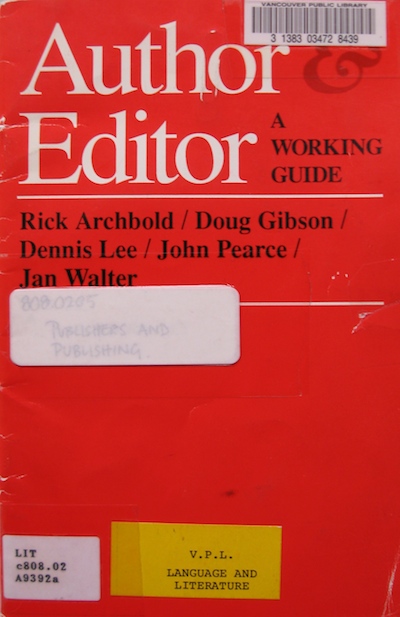
Author & Editor: A Working Guide

by Rick Archbold, Doug Gibson, Dennis Lee, John Pearce, and Jan Walter

Author and Editor: A Working Relationship

“There are books, even great ones, that make their way into print without ever being touched by an editor’s pencil, just as there are babies born without midwife or doctor. But they are not the norm and the dangers involved—in both cases—are considerable.”
This booklet outlines what an author needs to know about the publishing process. It covers the basics of manuscript acquisition, the decision to publish, contracts, how a publisher decides on the format and selling price of a book, the publishing schedule, and finally, it provides insight into and advice on managing the working relationship of the author and editor. It presents all of this information into a short (only 35 pages) and very readable package.

Where to get it

Publisher: The Book and Periodical Development Council, Toronto, Canada
Date: 1983
ISBN: 0130539260
AbeBooks
Vancouver Library

Reviewed from a library copy of the book.

October 24, 2011

How to cite a Wikipedia page

Citations

To cite a Wikipedia page, look for “Tools” on the left side of the page and click on “Cite this page.” You will get a list of citations in different citation formats. The article author is given as “Wikipedia contributors.” Example: citing their “Cat” entry.

Copyright and reproducing Wikipedia content

A quick note about reproducing Wikipedia content: Wikipedia content is under copyright, but most of it is licensed under terms that allow at least some reuse. The terms usually allow you to reproduce the text unchanged if you credit the authors, but make sure you check the terms of use for the specific page you’re interested in. You may also have the right to change the text, although you may or may not be required to allow your changed version to be reproduced in turn.

September 27, 2011

What to put into a book proposal from Jennifer Worick and Kerry Colburn

At Red Pencil in the Woods last weekend I heard a great talk on how to write an effective book proposal from Jennifer Worick and Kerry Colburn of The Business of Books. Some of the key points were:

Why do you need to write a proposal?

A book proposal is like a business plan. It tells the publisher:
  • What your idea is
  • Why this idea is interesting and marketable
  • Why you are the right person to write this book
  • How the book can be marketed
Even if you are going to self-publish, the proposal helps you to focus your concept and find your readers.

The key parts of a proposal

Jen and Kerry recommend that you set out these main points. You can tailor the format for each publisher or agent’s specifications.
  1. Introduction: Explain and sell the general concept. Some good ways to begin are with a startling statement or statistic (75% of Americans . . .) or a question (What would you do if . . .).
  2. About the book: State the genre or category, e.g., where it will be shelved in the bookstore, and the format (hardcover, trade paperback, mass market paperback), dimensions, price range, etc.
  3. Competing titles: Get to know the section of the bookstore where your book will be shelved. Name four or five books in the same category and explain how your book is similar and where it is different. Focus on books that have been published in the last ten years, and any “category-killers.”
  4. About the author: What’s your connection to the material? What makes you easy to work with and marketable? Mention interesting achievements, past careers, and skills.
  5. Marketing: Present clippings and logs for any promotion you did for earlier books. Mention any events, seasonal tie-ins, or regional and historical connections that can be used to promote the book. Describe any social media platform that you can use to promote the book with giveaways, contests, etc.
  6. Outline: Show that you know what the structure of the book will be.
  7. Sample text: Depends what the publisher or agent requests, but usually the introduction and one chapter.
  8. Extra materials: Include material that supports your proposal. It might be clippings to illustrate trends that you described, more information about you, and even audio and video clips that show you giving interviews or doing demos from the book.

More information on writing proposals and query letters

September 12, 2011

The Artful Edit: On the Practice of Editing Yourself by Susan Bell

Book cover: The Artful Edit by Susan Bell

Be your own editor

You won’t always get the perfect editor for your book, and you can’t rely on editors having time to do all the work they’d like to. Be your own editor as much as you can.

Susan Bell’s The Artful Edit is a guide for writers to help them edit their own work and to get the most out of their collaboration with an editor. Bell considers different strategies for editing during the writing process and suggests ideas for getting a fresh view of your draft. She then deals with the nuts and bolts of what to look for when editing. Later in the book, she steps back to look at the role of editing in art by interviewing non-print artists about how editing has improved their work and looking at some famous writer–editor relationships.

The book contains a lot of practical advice and examples. There are checklists and exercises to help you focus on specifics. Bell quotes from letters between F. Scott Fitzgerald and his editor, Max Perkins, to show how they worked on The Great Gatsby and quotes passages from different drafts of the manuscript to show the changes they made.

Although the book has some concrete stylistic advice (remove excessive “be” verbs, watch out for redundancy), this is not a style guide. Read it if you’re interested in larger issues (intention, structure, theme) and if you’re interested in thoughts about the role of the editor in creative writing.

Be a mechanic, not a judge. When you edit, do not ask yourself: Do I like this? Ask instead: Does this compel me and can I follow it? If the answer is no, figure out why.

—Susan Bell, The Artful Edit

Tips for getting distance from your draft

From The Artful Edit

  • Read it aloud, with or without an audience
  • Print it in a different font
  • Read it in different surroundings
  • Take a long break: don’t look at the manuscript at all for a few weeks
  • Go through the manuscript with someone else
  • Hang the pages on a line or lay them out on the floor to help you visualize the flow and layout
  • Send it away: giving your manuscript to someone else can make you see it with new eyes

Reviewed from a library copy of the book.

December 28, 2010

Spunk & Bite: A Writer’s Guide to Punchier, More Engaging Language & Style

Arthur Plotnik Spunk and Bite
“I can see dead writing” confesses Arthur Plotnik, and his mission is to teach people to make their writing come alive. To this end he advocates some controversial techniques (dialogue tags! obscure vocabulary! taken from the thesaurus!), but always with sensible advice about how to make them effective. He also goes after a few good, old-fashioned writing flaws, and I found his chapter on eliminating danglers (“Slathered with cream cheese, she brought over the bagels”) very useful.

The chapter on semicolons has a very good example of how the choice of punctuation affects the reader’s experience. Referring to President Kennedy’s famous “Ask not” line, Plotnik discusses how the pause between “Ask not what your country can do for you” and “Ask what you can do for your country” can be punctuated: comma, dash, period, colon, or semicolon? He says:

My own judgment would be based on these considerations:
  • The comma seems too hurried, too trivializing, as if one were saying: “Ask not for the large pizza, ask for the small one.”
  • The dash is too abrupt. With a dash, one expects an indirection, like, “Ask not what your country can do for you—ask how you can get heartburn relief.”
  • A period (full stop) allows time to anticipate the locution and to think, “Yeah, yeah, I get it.”
  • And a colon warns of some tedious enumeration: “Ask not what your country can do for you: Ask what you can do about poverty; ask what you can do about the environment; ask what you can . . .”
For more great writing advice from Arthur Plotnik, see Better than Great: A Plenitudinous Compendium of Wallopingly Fresh Superlatives (review), and his new edition of The Elements of Expression: Putting Thoughts into Words (review).

Reviewed from a copy borrowed from the library.